Frequently Asked Questions
Getting Started
What is Ango Hub and what problems does it solve?
Ango Hub is a data annotation and workflow management platform designed to help teams efficiently label, review, and manage datasets for machine learning. It supports multiple data types and provides tools for annotation, automation, and collaboration.
How do I create my first project in Ango Hub?
To create a project, navigate to the Projects page and click Create Project. Enter a project name and description, then click Create. Once your project is created, you can proceed to configure its settings, upload assets, define your ontology, and set up workflow stages.
For more details, refer to the Projects documentation page.
What types of data can I upload?
Ango Hub supports a wide range of data types. For a complete list of supported asset file types, please refer to the Supported Asset File Types documentation page.
How do I invite team members to my organization?
You can invite users from the Organization page by navigating to the Members tab. Enter the user’s email address, assign the appropriate role, and send the invitation. For more details, refer to the Organizations documentation page.
What are the different user roles and permissions?
Ango Hub defines two types of user roles: organization-level roles and project-level roles.
Organization-level roles include Owner, Admin, and Member.
Project-level roles include Labeler, Reviewer, Lead, and Manager.
For more details, refer to the User Roles documentation page.
Assets
How do I import assets into an Ango Hub project?
There are multiple ways to import assets into Ango Hub. For detailed instructions, please refer to the Import Assets documentation page.
What is the difference between assets, annotations, tasks, and projects?
Projects: The top-level containers where you organize your work. A project brings together your datasets, team members, ontology, and workflow configuration in a single place.
Assets: The raw data files within a project, such as images, videos, documents, or audio files. Assets represent the content that needs to be annotated.
Tasks: The units of work generated from assets. Tasks move through workflow stages (e.g., labeling, review) and are assigned to users for annotation and quality control.
Annotations: The labels or structured information added to assets during a task. Annotations are created using labeling tools (e.g., bounding boxes, polygons, classifications) and represent the ground truth data used for machine learning.
Can I upload and annotate large datasets? Are there any limits?
Yes, Ango Hub is designed to support large-scale datasets. For optimal performance, we recommend using batch uploads or ingesting data via the API/SDK.
For details on platform limits and best practices, please refer to the Performance & Compatibility Considerations documentation page.
How do I handle duplicate or corrupted files?
It is recommended to validate files before uploading.
Ango Hub does not restrict duplicate uploads, meaning the same file (by name or content) can be uploaded multiple times. If deduplication is required, it should be handled prior to ingestion, or duplicate assets should be removed after upload.
If a corrupted file is opened in the labeling editor, the platform will display an error message indicating that the asset cannot be rendered.
Can I directly annotate data I have stored on cloud storage services?
Yes. Ango Hub allows you to connect to supported cloud storage providers and work directly with your data without manual uploads. For step-by-step instructions, please refer to the Importing Cloud Assets documentation page.
Do I have to convert PDFs to images before labeling?
No. Ango Hub supports native PDF annotation, allowing you to label PDF files directly without any conversion. For more details please refer to the PDF Labeling Editor documentation page.
I'm unable to open files from my bucket in the editor and see the error: “Sorry, the data couldn’t be loaded properly.” What should I do?
This is likely to be an issue with how CORS is set up in the bucket where your assets are located.
In order for Hub to display your assets in AWS S3 or GCP, you need to set up CORS following the steps outlined in Set up CORS page. Try to open the assets again after setting up CORS as mentioned in the page.
If you still see the error, please open a ticket through our built-in help system, clicking on the question mark located at the top right of the screen.
Labeling
What annotation tools are available in Ango Hub?
Ango Hub provides a comprehensive set of annotation tools to support a wide range of data types and use cases. For a complete and up-to-date list of supported annotation tools, please refer to the Labeling Classes documentation page.
How can I perform targeted OCR on images
You can perform targeted OCR on images by adding a Bounding Box tool to your project and enabling the Targeted OCR option. This allows you to extract text from specific regions within an image during annotation.
For more details, please refer to the Bounding Box labeling tool documentation page.
How can I view an object's "objectId" when selection an annotation?
Either right-click on the annotation, click on the three dots, and click on "Copy Object ID", or when in the labeling editor, click on the Quick Settings toggle (
) and enable Show Annotation ID on Hover to see the ID when hovering over the object.
I am not seeing the "Submit" button. Instead, I see a button saying "Un-assign me".
This happens because, even though you have already annotated this task, as a result of the project's workflow, you have been assigned to annotate it again as part of the consensus calculation, or to review your own task, which is not allowed. Please click on "Un-assign me" and the task will be unassigned from you and put back in the queue for other project members to annotate or review.
How do I review someone's labeling task?
To review a labeling task, you need to be assigned a review role within the project. Tasks are routed to review stages based on your workflow configuration.
Once assigned, you can open the task in the labeling editor, evaluate the annotations, and take appropriate actions such as approving, rejecting, or providing feedback for corrections.
For step-by-step instructions and best practices, please refer to the Reviewing documentation page.
I see an "Unknown Classification" warning when opening a task.
This means that this classification was removed from the project's category schema after it was answered in the task.

From your project's Settings -> Category Schema section, by clicking on the "Show/Hide Version History" button, you may browse previous versions of your project's category schema to attempt to restore it.

I'm experiencing poor performance of the tool. Where can I know more?
Please refer to the Performance & Compatibility Considerations documentation page.
Model Integration
How can I import existing annotations (pre-labels) to Ango Hub?
You can import existing annotations into Ango Hub either through the UI or the SDK, depending on your workflow. In the UI, annotations can be uploaded in a supported JSON format during data ingestion or via the import interface, while for programmatic and large-scale operations, you can use the SDK’s import_labels function. For detailed instructions, supported formats, and configuration options, please refer to the Importing Annotations documentation page.
Can I use my own ML model with Ango Hub?
Yes, you can use your own ML model with Ango Hub in multiple ways depending on your needs. You can run your model externally and import the generated annotations into Ango Hub via the UI or SDK's import_labels function, or you can integrate your model directly into the platform using a Model Plugin to enable live inference within your workflows.
How does pre-labeling work in Ango Hub?
Pre-labeling in Ango Hub enables you to automatically generate initial annotations using model predictions, reducing manual labeling effort and accelerating your workflow.
These auto-generated labels serve as a starting point for annotators, who can review, evaluate, and correct them as needed, ensuring high-quality final outputs while significantly improving efficiency and consistency across your dataset.
How do I perform model evaluation on Ango Hub?
There are currently a few ways to evaluate the outputs of your models. Please refer to this video for a visual explanation on how to accomplish this on Ango Hub:
If your network does not allow access to the above video, you may download it by clicking on the following link:
Plugins
What are plugins in Ango Hub?
The plugin infrastructure allows developers to extend Ango Hub’s core capabilities with custom functionality. Plugins offer you to add new export formats, upload assets, integrate machine learning models, and much more seamlessly and efficiently. For more details, please refer to the Plugin documentation.
How do I install or use a plugin?
You can install plugins directly from the Plugin Directory within your organization. Once added, they become available for use in your workflows and projects. For more details, please refer to How to Add Plugins to Your Organization and How to Use Plugins in Your Project documentation pages.
Can I build custom plugins?
Yes. Developers can create custom plugins using the Ango Hub SDK to extend platform functionality, such as building custom file explorers, model integrations, and export workflows. For more details, please refer to the Plugin Developer Documentation page.
What are some common use cases for plugins?
Plugins extend Ango Hub's functionality and support a wide range of workflows. Common use cases include file import and data ingestion, model integrations for pre-labeling or inference, and exporting data in custom formats.
Ango Hub also provides a set of plugins that are officially supported and maintained by the Ango team. For more details, please refer to the First-Party Ango Plugins documentation page.
If you have specific requirements, you can build your own plugins. For more details, please refer to the Plugin Developer Documentation page.
How can I monitor the status of a plugin run?
You can track the progress and status of your plugin runs directly from the Plugin Sessions window. This interface provides real-time visibility into each run, including its current state, logs, and any errors encountered. For more details, please refer to the Monitoring Plugin Progress page.
I'm uploading assets with the File Explorer plugin, but I don't want to upload an asset if it's already been uploaded before. How can I do that?
You can avoid uploading duplicate assets by enabling the prevent_duplicates parameter in the File Explorer plugin’s configuration JSON. When set to true, the plugin checks for existing assets and skips any duplicates during upload.
How do I know whether a plugin is live or not?
In the plugin list within your project, each plugin has a status indicator next to the “Live” label. A green icon means the plugin is live and active, while a red icon indicates that it is not currently live.
Who should I contact if a plugin goes down?
In the Plugin Directory and in the plugin’s Run Dialog, you can see the email of the person who created and maintains the plugin. It's in the bottom-right corner of the plugin's icon. You may contact them.
Export
What export formats are supported in Ango Hub?
Ango Hub provides a flexible export system to support a wide range of use cases. By default, annotations can be exported in Ango Hub's native JSON format.
In addition, built-in export plugins allow you to convert this format into commonly used standards such as COCO, YOLO, and KITTI.
For segmentation tasks, the Ango to Mask plugin enables exporting annotations as mask images for both image and video data.
For classification projects, the CSV Export Classification plugin allows you to export results in a tabular CSV format.
If you have custom export requirements, you can use the SDK's export function, develop your own Export Plugin, or reach out to the team for further support.
How do I export annotations for a specific batch?
You can export annotations for a specific batch. In the UI (including built-in export and export plugins), you can simply select the desired batch through the available filters before running the export.

If you are using the SDK, you can specify the target batch by providing the appropriate batch ID within the options parameter of the export function. This allows you to precisely control which batch data is included in the export.
Why is my export empty or missing data?
An empty or incomplete export is typically caused by incorrect batch and stage filters. When exporting via the UI, make sure the selected batch and stage actually contain assets with annotations.
If you are using the SDK, ensure that you are passing the correct identifiers, such as batch names or IDs and stage names or IDs, and that they match your project data.
Workflow & Project Management
What happens if I change the ontology of a project while people are annotating tasks?
They will receive the new ontology after they have submitted the task they are currently working on. Please refer to the Managing the Project Ontology documentation page.
What happens when a task is sent back to the same stage?
It's assigned to the same user who originally labeled/reviewed it in that stage, and marked for labeling/reviewing again.
How to mute your notifications?
You can mute your notifications so that they don't pop up on your screen anymore. You will still receive notifications, the only difference is that to see them, you'll have to click on the bell icon.
When you mute notifications, you mute them for yourself only, not for the entire organization.
Click on the 'bell' icon on the top right corner to open the notification panel.

Enable the Mute toggle. Notifications will not pop up anymore, and will instead be delivered silently to your notification panel.

How to open an asset provided the Asset ID?
If you have an assetId (which you can find in the Task Info drawer on the right-hand side of the labeling editor, or from the SDK) and you wish to open that asset in the labeling editor, navigate to the following URL, replacing {assetId} with the asset ID.
https://imerit.ango.ai/asset/{assetId}
How to transfer project ontologies between projects?
Ango Hub allows you to copy the project ontology from one project and paste it in another, by following the below steps:
Navigate to the project containing the ontology you wish to copy.
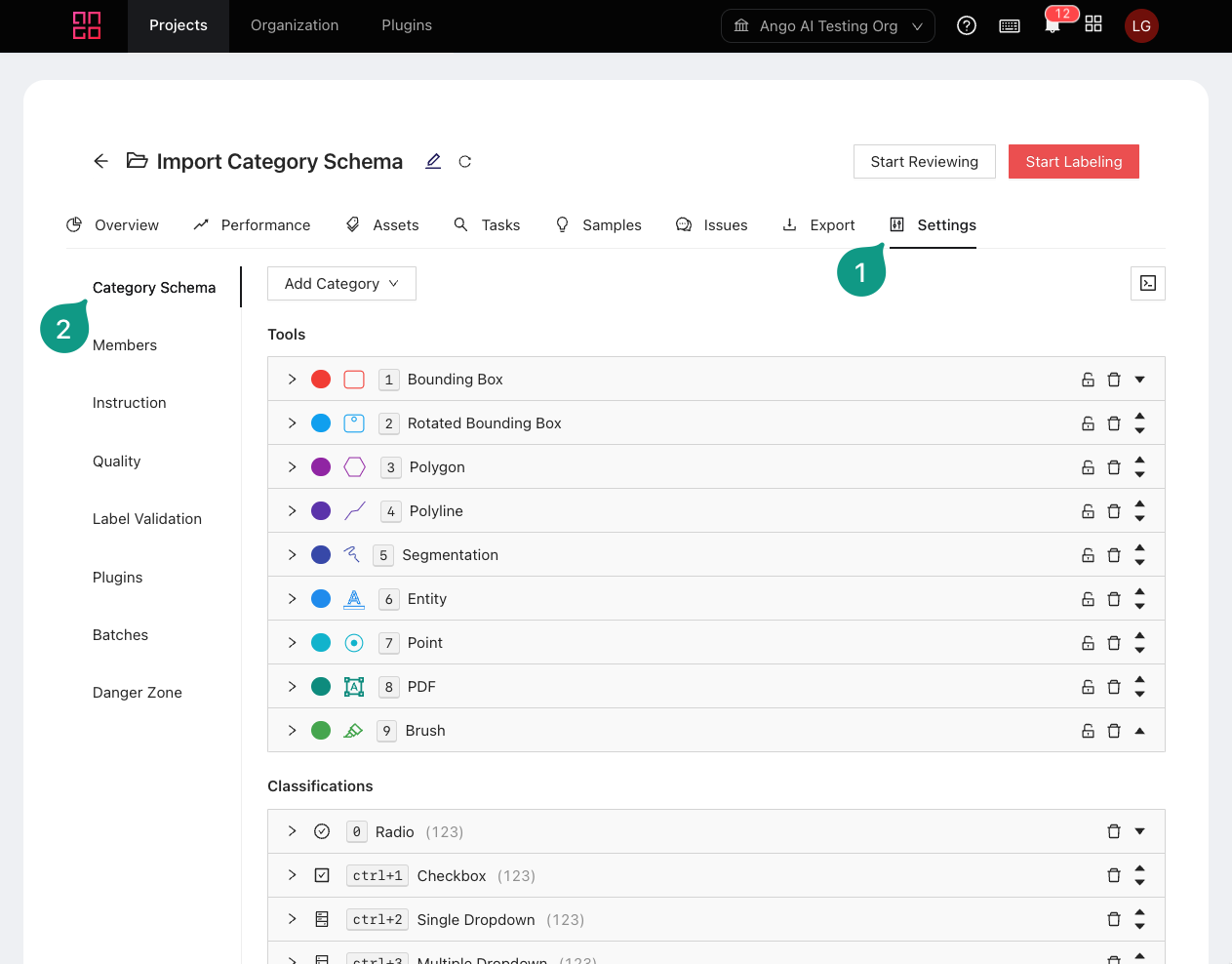
Navigate to the Settings tab, then the Category Schema section.

Click on the "code" button (1) on the right. A panel showing the project's ontology JSON will appear. Copy the JSON to your clipboard using the "copy" button (2).

Navigate to the project where you'd like to paste the ontology and follow the same steps, but instead of copying, paste the JSON you have just copied into the box.
Click on Save at the bottom of the page.
How to transfer project workflows between projects?
Ango Hub allows you to copy the project workflow from one project and paste it in another, by following the below steps:
Navigate to the project containing the workflow you wish to copy.
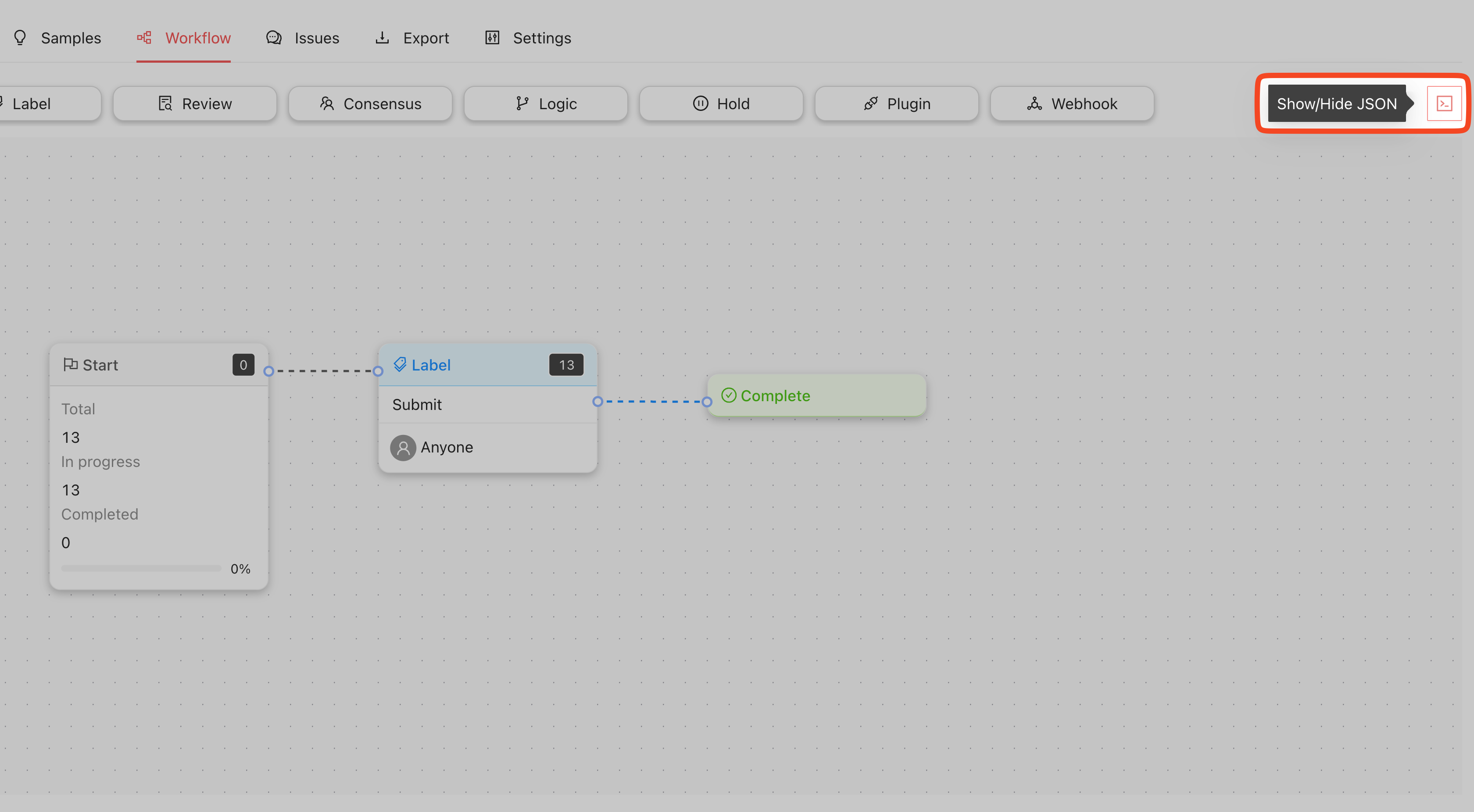
Navigate to the Workflow tab.
Click on the "code" button (1) on the right.

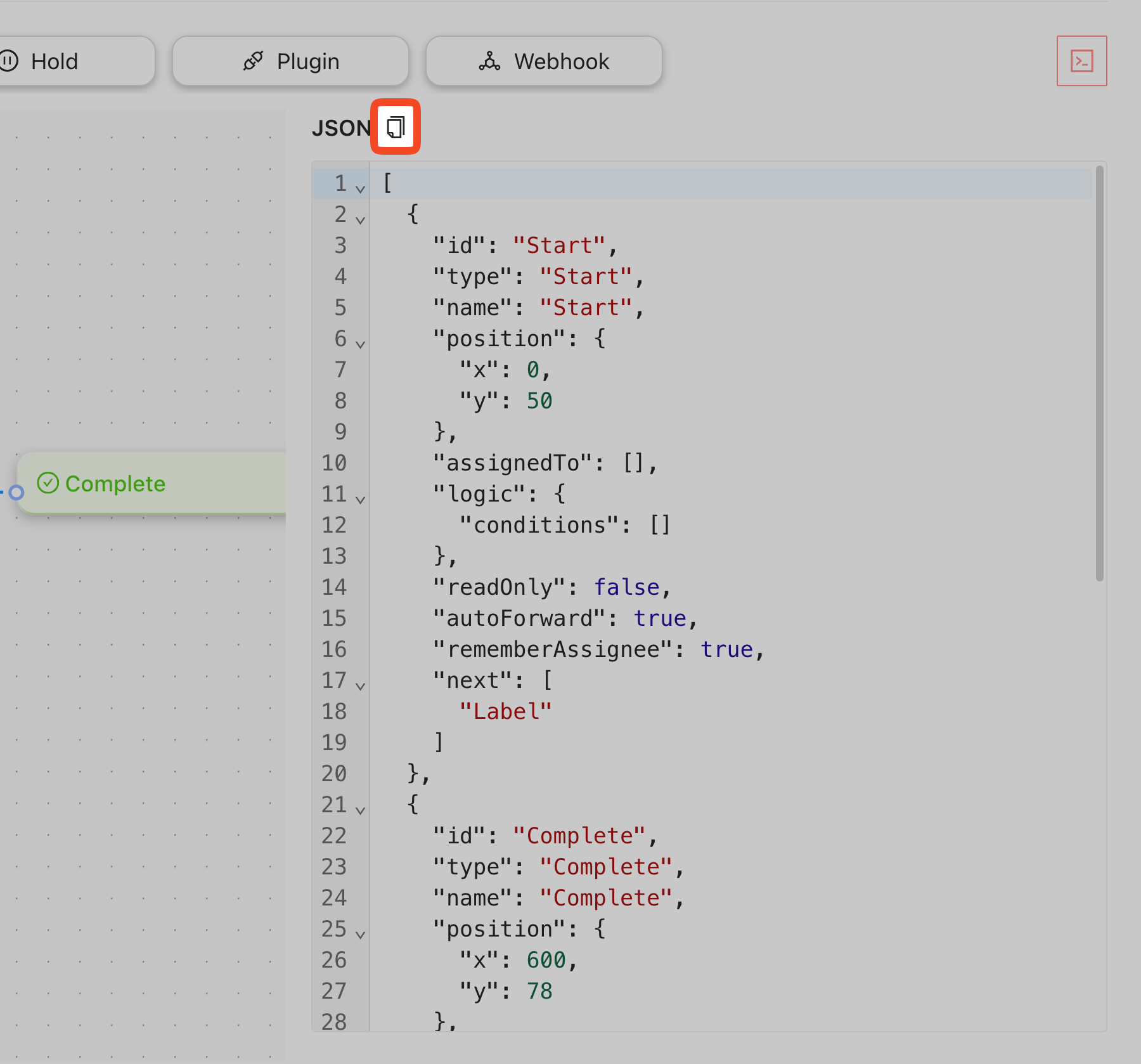
A panel showing the project's workflow JSON will appear. Copy the JSON to your clipboard using the "copy" button.

Navigate to the project where you'd like to paste the workflow and follow the same steps, but instead of copying, paste the JSON you have just copied into the box.
Click on Save to save the new workflow.
I get a "0 Tasks Labeled" alert when trying to pre-label tasks.
Most likely, you are attempting to pre-label tasks which are not in the Start stage. Only tasks in the Start stage can be pre-labeled.
By default, tasks skip the Start stage and are automatically forwarded to the stage connected to the output of Start. This is visible in the Workflow tab, when a dotted line runs from the output of Start to the input of another stage:

It is for this reason that by default, pre-labeling is disabled.
How to Activate Pre-Labeling and Pre-Label Tasks
Go to the Workflow tab, then click on the Start stage and disable the Auto Forward toggle. This will ensure tasks remain in the Start stage when created. The dashed line will turn to a fully filled-in line.
Import your pre-labels, ensuring the tasks you are trying to pre-label are currently in the Start stage.
When you are finished pre-labeling tasks, go to the Workflow tab again and click on the Start stage. Then, click on Next Stage. This will push all tasks in Start to the stage following it, sending them into the workflow.

API & SDK
How do I get my API key?
Click on your profile circle on the top-right corner and click on "Account". Alternatively, click here.

Enter the "API" tab.

If an API key is not present, click on the "Create Key" button to the right.

Once an API key is present, click on the Copy to Clipboard button next to it to copy it to your clipboard. You may now paste it where necessary.

Sharing your API key is the same as sharing your password.
Do not share your API key with anyone, unless you would also share your password with them.
How do I get an organization ID?
Each organization is assigned a unique ID. Here's how you can get it from the UI:
Navigate to your Account page.
You'll see a row called Organization ID. Click on the "Clipboard" button next to it to copy the ID to your clipboard.

How do I get a project ID?
To retrieve a Project ID from the UI:
Navigate to Projects page.
Search for your project and click to open it.
On the project page, click the copy icon next to the project title to copy the ID to your clipboard.
Alternatively, you can obtain the Project ID from the URL. Project URLs follow this format:
https://imerit.ango.ai/projects/<project_id>
Simply copy the <project_id> portion from the URL.
Security
How is my data protected?
All data is encrypted in transit and at rest across every deployment of Ango Hub, using current industry standards.
Do we need to move our data into your platform?
No. Ango Hub connects to your storage with scoped, revocable permissions and reads only what you authorize. Access is logged.
Can we run Ango Hub in our own environment?
Yes. Deploy on premises, in your private cloud, or in an air gapped setup for full isolation.
Last updated