> For the complete documentation index, see [llms.txt](https://docs.imerit.net/llms.txt). Markdown versions of documentation pages are available by appending `.md` to page URLs; this page is available as [Markdown](https://docs.imerit.net/data/importing-assets/asset-browser-import.md).
# Importing From Local Machine
Overview of importing files for labeling into Ango Hub from the local machine
Administrators can import [data](/data/data-in-ango-hub.md) to Ango Hub by simply dragging and dropping the [assets](/core-concepts/assets.md) they’d like to label.
Assets uploaded this way will be stored in the `/uploaded-data/` folder within Ango Hub. By default, these assets will be assigned an [*External ID*](/core-concepts/assets.md#External-ID) equal to their filename, including the extension.
## How to import assets from the browser
From your project’s dashboard, enter the *Assets* tab and click on *Add Data*.
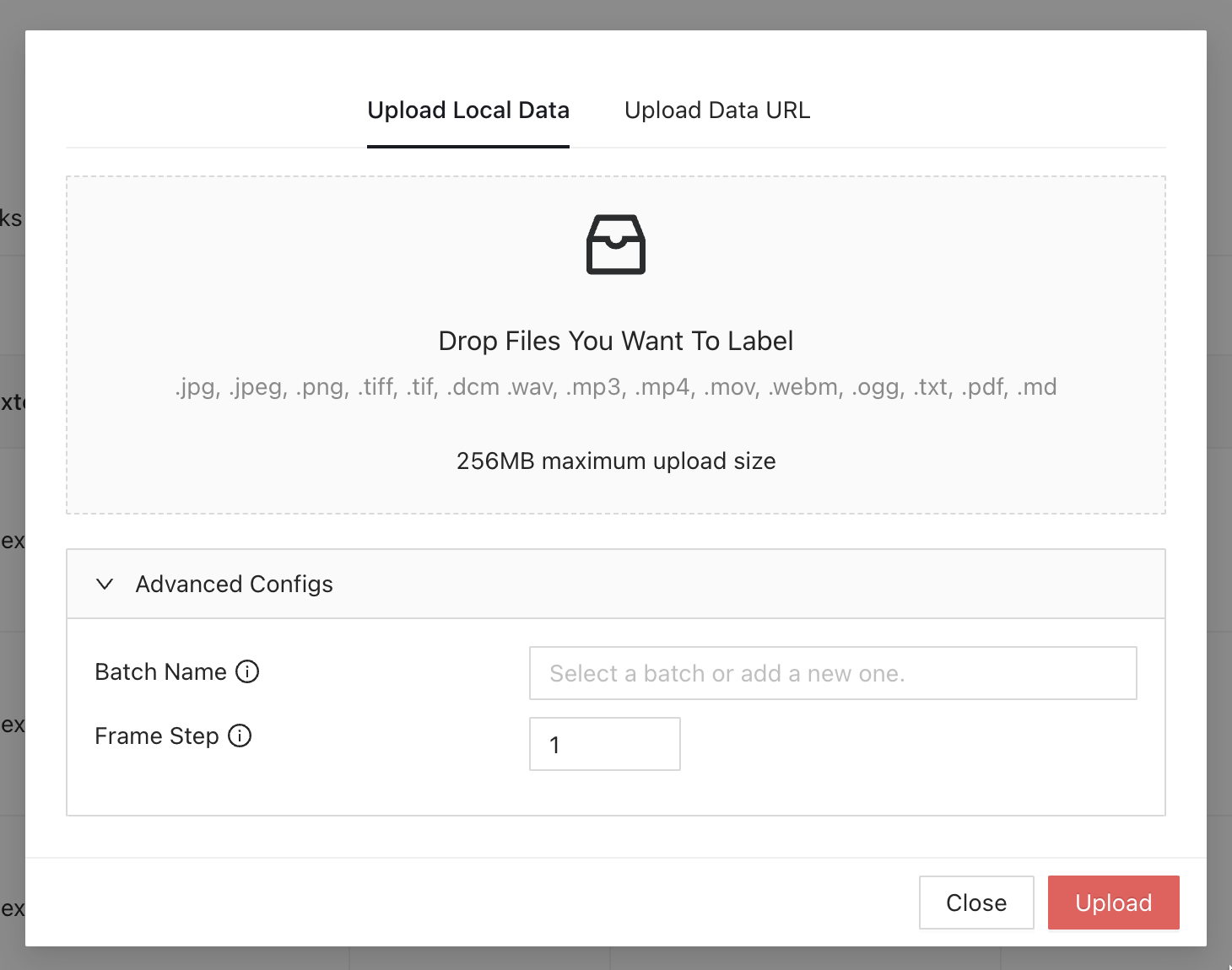
A dialog will pop up. Drag the assets you would like to upload to the box in the center. Alternatively, click on the box to open your system’s file explorer.
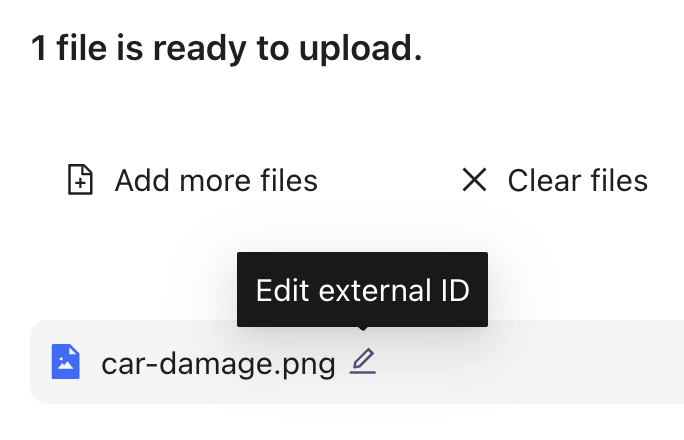
After adding your files, you may assign a different External ID to any file before uploading it. Click the pencil icon next to the file name, enter the new External ID, and press *Enter*.
If more than one file has the same External ID, Ango Hub will display a warning. Duplicate External IDs do not prevent the files from being uploaded.
## Local Upload limits
You may upload up to 60,000 files at one time with Local Upload.
The total size of all files selected for one Local Upload may not exceed 5 GB. For example, you can upload one 5 GB file, or multiple smaller files whose combined size is 5 GB or less.
{% hint style="danger" %}
For video files uploaded this way, Ango Hub extracts the video's metadata during processing before the asset becomes available for labeling.
This includes metadata such as frame rate and total frame count.
{% endhint %}
If video metadata extraction fails for a retryable reason, project managers can retry it from the project's *Assets* tab. In the asset's *Tasks* column, click the *Retry metadata extraction* button next to *Metadata extraction failed*. To retry multiple failed video assets at once, select them in the *Assets* table and choose *Retry Metadata Extraction* from the bulk actions menu.
Ango Hub also automatically retries temporary processing failures, such as transaction or network interruptions. Invalid or unsupported files remain permanently failed and are not retried automatically.
{% hint style="warning" %}
If your source video uses variable frame rate (VFR), Cloud Import may preserve the metadata more accurately, but VFR videos are still not supported for frame-accurate annotation. See [Variable Frame Rate (VFR) Video Compatibility](/data/data-in-ango-hub/variable-frame-rate-videos.md).
{% endhint %}
### Import Options
**Batch Name**: If you select one or more [batches](/core-concepts/batches.md) from this dropdown, the assets you will upload will be assigned to the selected batches.
**Frame Step**: If 1, you will be able to see and label each frame of a video. If 2, you will see and label 1 frame every 2, and so on.
Click on *Upload* to import your assets. After uploading, they will appear in the *Assets* tab.
{% hint style="info" %}
It is also possible to upload assets through our [API](/api/api-documentation-deprecated.md) and [SDK](/sdk/sdk-documentation.md).
{% endhint %}
---
# Agent Instructions
This documentation is published with GitBook. GitBook is the documentation platform designed so that both humans and AI agents can read, navigate, and reason over technical content effectively. Learn more at gitbook.com.
## Querying This Documentation
If you need additional information that is not directly available in this page, you can query the documentation by asking a question.
Perform an HTTP GET request on the following URL with the `ask` and `goal` query parameters:
```
GET https://docs.imerit.net/data/importing-assets/asset-browser-import.md?ask=&goal=
```
`ask` is the immediate question: it should be specific, self-contained, and written in natural language.
`goal` is what the user is ultimately trying to achieve, the reason they need the answer. Sharing it helps GitBook give you a better, more relevant answer. A goal is most helpful when it describes the outcome the user wants rather than restating the question. For example, with `ask=how do I create an API token`, a goal like `automate deployments from our CI pipeline` lets GitBook tailor the answer to that use case.
The response will contain a direct answer to the question and relevant excerpts and sources from the documentation.
Use this mechanism when the answer is not explicitly present in the current page, you need clarification or additional context, or you want to retrieve related documentation sections.