> For the complete documentation index, see [llms.txt](https://docs.imerit.net/llms.txt). Markdown versions of documentation pages are available by appending `.md` to page URLs; this page is available as [Markdown](https://docs.imerit.net/core-concepts/label-sets-ontologies.md).
# Category Schema (Ontologies)
Setting up your labeling project's ontology on Ango Hub
A project’s category schema (also known as *ontology*) is the list of labeling tools available in the project.
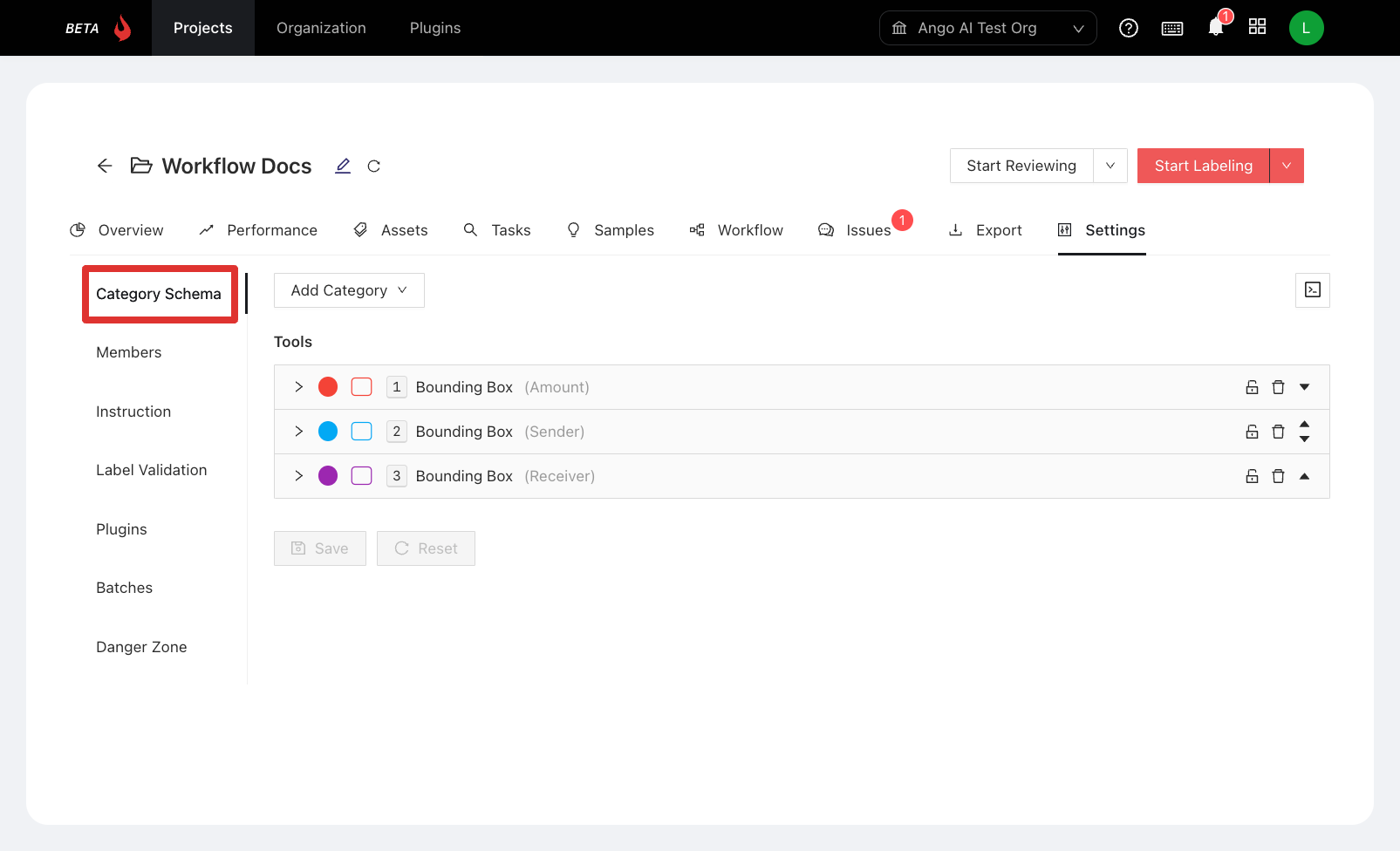
Ango Hub allows project owners to set the project’s ontology directly from the *Category Schema* section of the *Settings* page.
The ontology created from this section is then reflected in the left sidebar of the labeling editor:

## How to create a project ontology
From the project’s *Settings* tab, enter the *Category Schema* section.
Click on the *Add Category* button and choose the labeling tool to add. Each tool has a slightly different setup process. [See here for a list of all labeling tools available in Ango Hub, and how to add them to your project.](/labeling/labeling-tools.md)
For a guide on how to create nested classifications, [see here](/labeling/labeling-tools/tools/nested-classifications.md).
## Make categories read-only in specific stages
From **Settings > Category Schema**, expand a tool or classification. In **Read-only Stages**, select the Label, Review, or Consensus stages where the category should be locked, then click **Save**. Selecting a Consensus stage applies to all its branches.
At the selected stages, annotators cannot create annotations with that category or edit, move, or delete existing ones. The annotations remain visible and are exported as usual. A padlock identifies read-only categories in the editor. At other stages, the category remains editable.
Nested classifications follow their parent category's setting. To change or remove a restriction, return to **Read-only Stages** and update the selection. If a selected stage is deleted from the workflow, it appears as **Deleted stage** and can be removed from the list.
{% hint style="info" %}
This setting is not available in 3D MSFT projects. It differs from disabling a category with the category schema's padlock, which only prevents new annotations and still allows existing ones to be edited.
{% endhint %}
## How to copy a project's ontology to a new project
Please [check this guide](/how-to/transfer-project-ontologies-between-projects.md).
## Browse and Restore Previous Ontology Versions
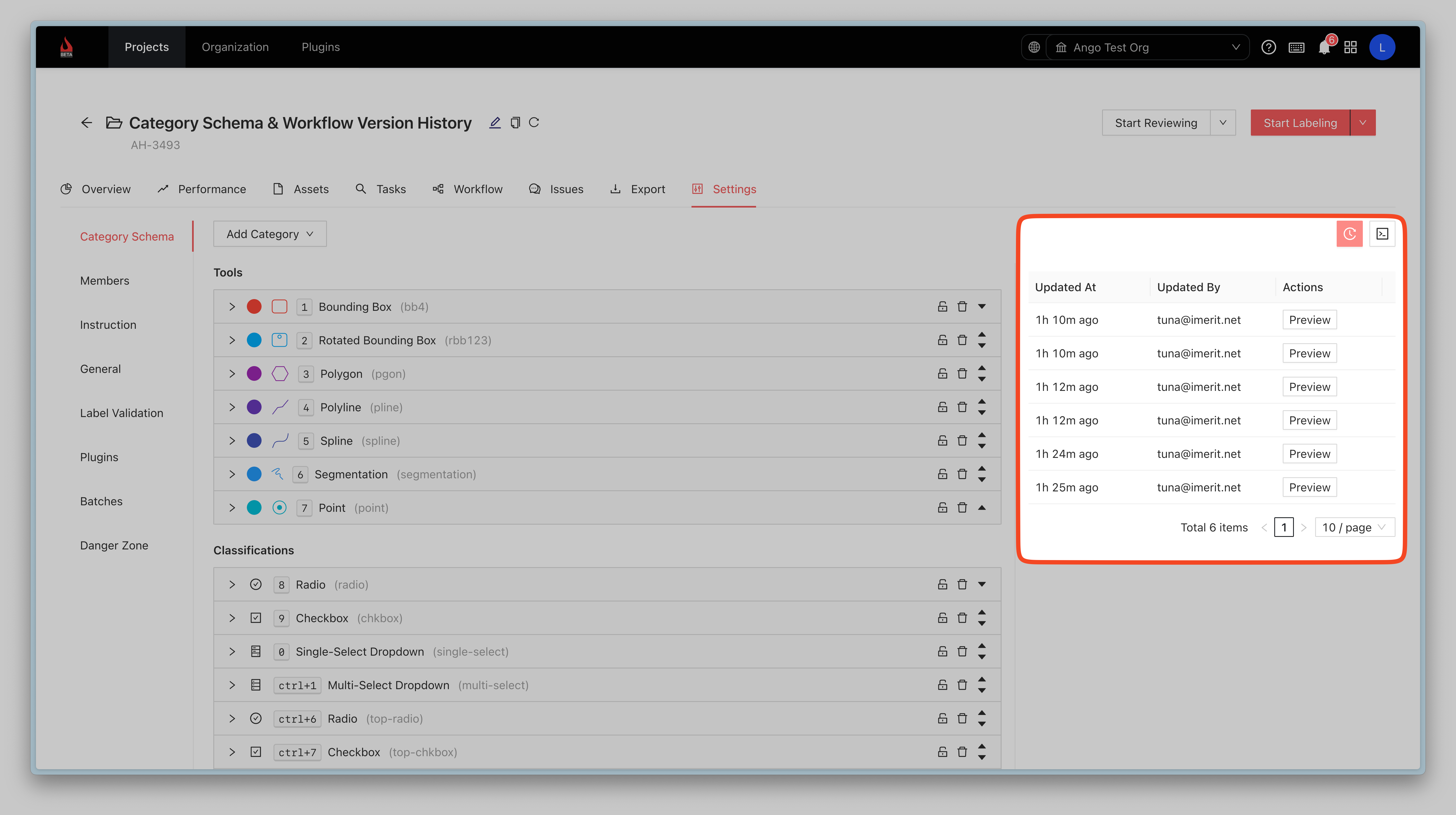
From the Settings tab, in the *Category Schema* section, click on the "History" icon on the top-right to open a history of all workflow versions in the current project.
{% hint style="info" %}
Category Schema history started being recorded on March 12, 2025. Versions before then had not been saved.
{% endhint %}
To view a previous version of this project's ontology, click on *Preview*. To restore it, click on *Save* while the version you need is previewed.
---
# Agent Instructions
This documentation is published with GitBook. GitBook is the documentation platform designed so that both humans and AI agents can read, navigate, and reason over technical content effectively. Learn more at gitbook.com.
## Querying This Documentation
If you need additional information that is not directly available in this page, you can query the documentation by asking a question.
Perform an HTTP GET request on the following URL with the `ask` and `goal` query parameters:
```
GET https://docs.imerit.net/core-concepts/label-sets-ontologies.md?ask=&goal=
```
`ask` is the immediate question: it should be specific, self-contained, and written in natural language.
`goal` is what the user is ultimately trying to achieve, the reason they need the answer. Sharing it helps GitBook give you a better, more relevant answer. A goal is most helpful when it describes the outcome the user wants rather than restating the question. For example, with `ask=how do I create an API token`, a goal like `automate deployments from our CI pipeline` lets GitBook tailor the answer to that use case.
The response will contain a direct answer to the question and relevant excerpts and sources from the documentation.
Use this mechanism when the answer is not explicitly present in the current page, you need clarification or additional context, or you want to retrieve related documentation sections.