> For the complete documentation index, see [llms.txt](https://docs.imerit.net/llms.txt). Markdown versions of documentation pages are available by appending `.md` to page URLs; this page is available as [Markdown](https://docs.imerit.net/3d-multi-sensor-fusion/labeling/3d-multi-sensor-fusion-labeling-editor/key-features/unify-dimension.md).
# Unify Dimension
The Unify Dimension feature allows users to maintain consistency in object size across frames. When activated, it applies the cuboid size from the current frame to all frames where the object is visible.
{% hint style="info" icon="lightbulb-on" %}
Enhances efficiency by reducing the need for manual resizing in each frame and helps lock the dimensions.
{% endhint %}

***
## Benefits
* Reduces manual adjustments across multiple frames.
* Ensures accurate and consistent object representation.
* Speeds up the annotation workflow by minimizing repetitive edits.
***
## Steps to Use Unify Dimension
{% stepper %}
{% step %}
#### Identify and create the base cuboid
Identify an object as soon as it appears and create a cuboid for it.
{% endstep %}
{% step %}
#### Refine position across frames
Proceed to the next frames and readjust the cuboid position until you find the frame where the object is most visible (i.e., has the most points).
{% endstep %}
{% step %}
#### Adjust dimensions using points
Adjust the annotation based on the points that define the true dimensions of the cuboid.
{% endstep %}
{% step %}
#### Apply Unify Dimension
Click the Unify Dimension button to propagate the selected cuboid’s dimensions across all frames where the object is visible. The system will automatically resize the cuboid in other frames and then lock the dimension to discourage accidental changes.
{% endstep %}
{% endstepper %}
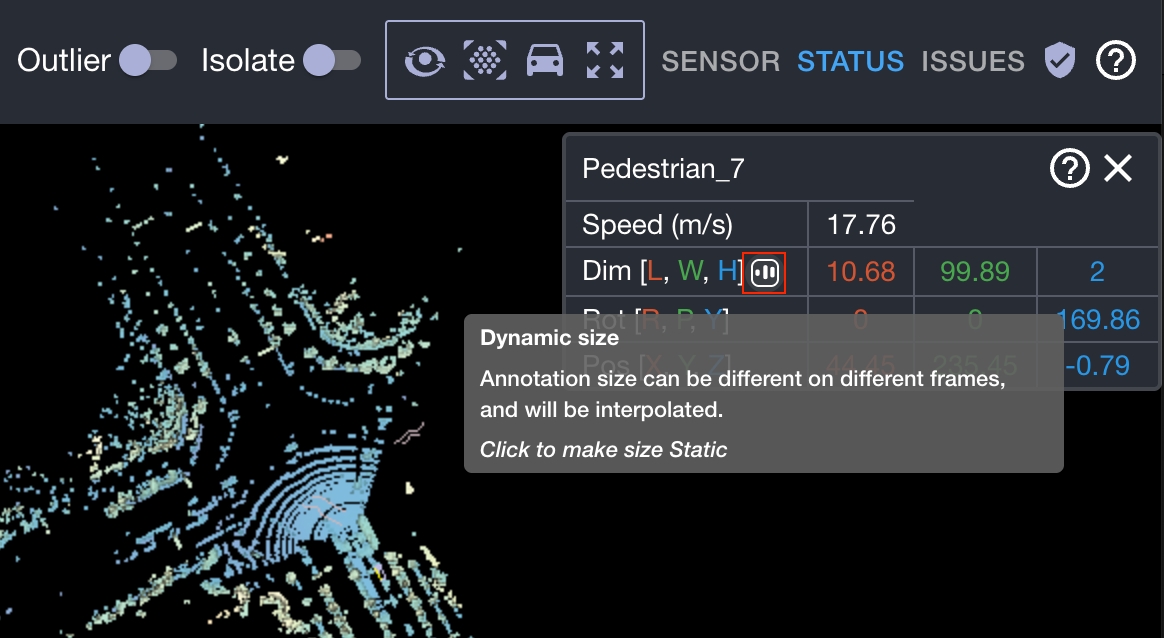
In the red box below, the varying rectangle sizes illustrate that the cuboid currently can have dynamic dimensions.
 ***
## Use Case
### The object changes dimension for a few frames
{% stepper %}
{% step %}
#### Identify the frame range
Find the frame range where the object changes dimension:
* starting frame where the dimension change begins — x
* (optional) ending frame where the dimension returns to the original — y
{% endstep %}
{% step %}
#### Create a keyframe before the change
Navigate to frame x - 1 and create a keyframe.\
(See: )
{% endstep %}
{% step %}
#### Create a keyframe after the change
Navigate to frame y + 1 and create a keyframe.\
(See: )
{% endstep %}
{% step %}
#### Allow varying cuboid sizes and adjust
Click the button to allow cuboid sizes to vary across frames, then adjust the dimension of the cuboid between x and y. Find the frame where the cuboid is most visible (has the most points), then apply Unify Dimension for a faster, more consistent annotation process.
{% endstep %}
{% endstepper %}
The image below shows uniform rectangle sizes to illustrate a single dimension applied across the sequence.
***
## Use Case
### The object changes dimension for a few frames
{% stepper %}
{% step %}
#### Identify the frame range
Find the frame range where the object changes dimension:
* starting frame where the dimension change begins — x
* (optional) ending frame where the dimension returns to the original — y
{% endstep %}
{% step %}
#### Create a keyframe before the change
Navigate to frame x - 1 and create a keyframe.\
(See: )
{% endstep %}
{% step %}
#### Create a keyframe after the change
Navigate to frame y + 1 and create a keyframe.\
(See: )
{% endstep %}
{% step %}
#### Allow varying cuboid sizes and adjust
Click the button to allow cuboid sizes to vary across frames, then adjust the dimension of the cuboid between x and y. Find the frame where the cuboid is most visible (has the most points), then apply Unify Dimension for a faster, more consistent annotation process.
{% endstep %}
{% endstepper %}
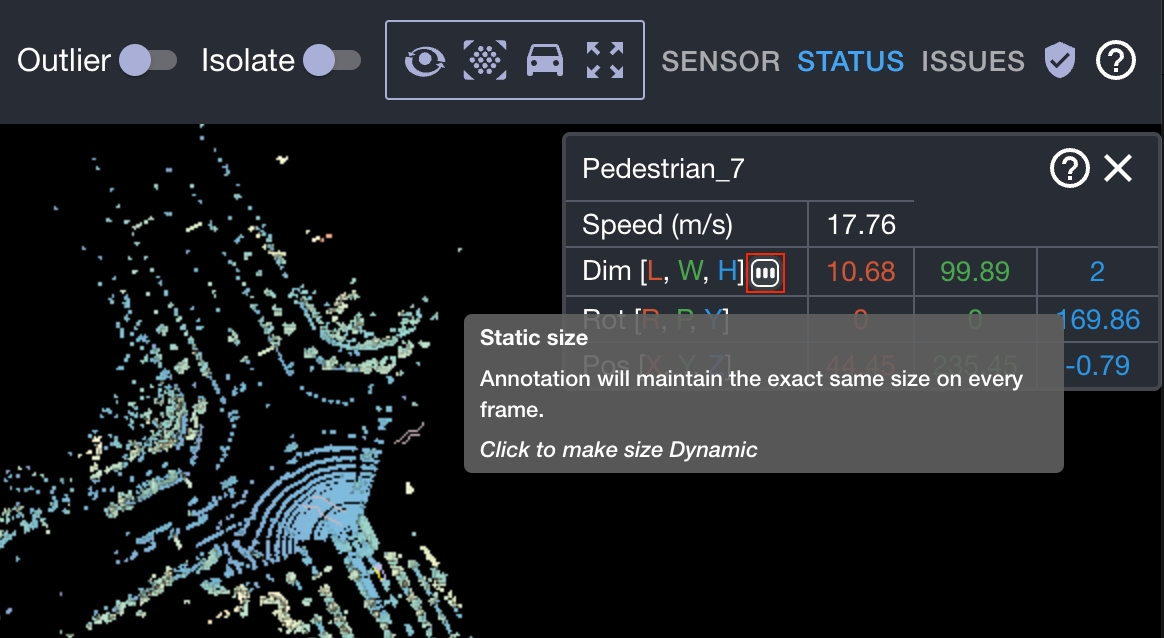
The image below shows uniform rectangle sizes to illustrate a single dimension applied across the sequence.
 Find the frame where the cuboid is most visible (i.e., has the most points), then apply Unify Dimension for a faster, more consistent annotation process.
---
# Agent Instructions
This documentation is published with GitBook. GitBook is the documentation platform designed so that both humans and AI agents can read, navigate, and reason over technical content effectively. Learn more at gitbook.com.
## Querying This Documentation
If you need additional information that is not directly available in this page, you can query the documentation by asking a question.
Perform an HTTP GET request on the following URL with the `ask` and `goal` query parameters:
```
GET https://docs.imerit.net/3d-multi-sensor-fusion/labeling/3d-multi-sensor-fusion-labeling-editor/key-features/unify-dimension.md?ask=&goal=
```
`ask` is the immediate question: it should be specific, self-contained, and written in natural language.
`goal` is what the user is ultimately trying to achieve, the reason they need the answer. Sharing it helps GitBook give you a better, more relevant answer. A goal is most helpful when it describes the outcome the user wants rather than restating the question. For example, with `ask=how do I create an API token`, a goal like `automate deployments from our CI pipeline` lets GitBook tailor the answer to that use case.
The response will contain a direct answer to the question and relevant excerpts and sources from the documentation.
Use this mechanism when the answer is not explicitly present in the current page, you need clarification or additional context, or you want to retrieve related documentation sections.
Find the frame where the cuboid is most visible (i.e., has the most points), then apply Unify Dimension for a faster, more consistent annotation process.
---
# Agent Instructions
This documentation is published with GitBook. GitBook is the documentation platform designed so that both humans and AI agents can read, navigate, and reason over technical content effectively. Learn more at gitbook.com.
## Querying This Documentation
If you need additional information that is not directly available in this page, you can query the documentation by asking a question.
Perform an HTTP GET request on the following URL with the `ask` and `goal` query parameters:
```
GET https://docs.imerit.net/3d-multi-sensor-fusion/labeling/3d-multi-sensor-fusion-labeling-editor/key-features/unify-dimension.md?ask=&goal=
```
`ask` is the immediate question: it should be specific, self-contained, and written in natural language.
`goal` is what the user is ultimately trying to achieve, the reason they need the answer. Sharing it helps GitBook give you a better, more relevant answer. A goal is most helpful when it describes the outcome the user wants rather than restating the question. For example, with `ask=how do I create an API token`, a goal like `automate deployments from our CI pipeline` lets GitBook tailor the answer to that use case.
The response will contain a direct answer to the question and relevant excerpts and sources from the documentation.
Use this mechanism when the answer is not explicitly present in the current page, you need clarification or additional context, or you want to retrieve related documentation sections.